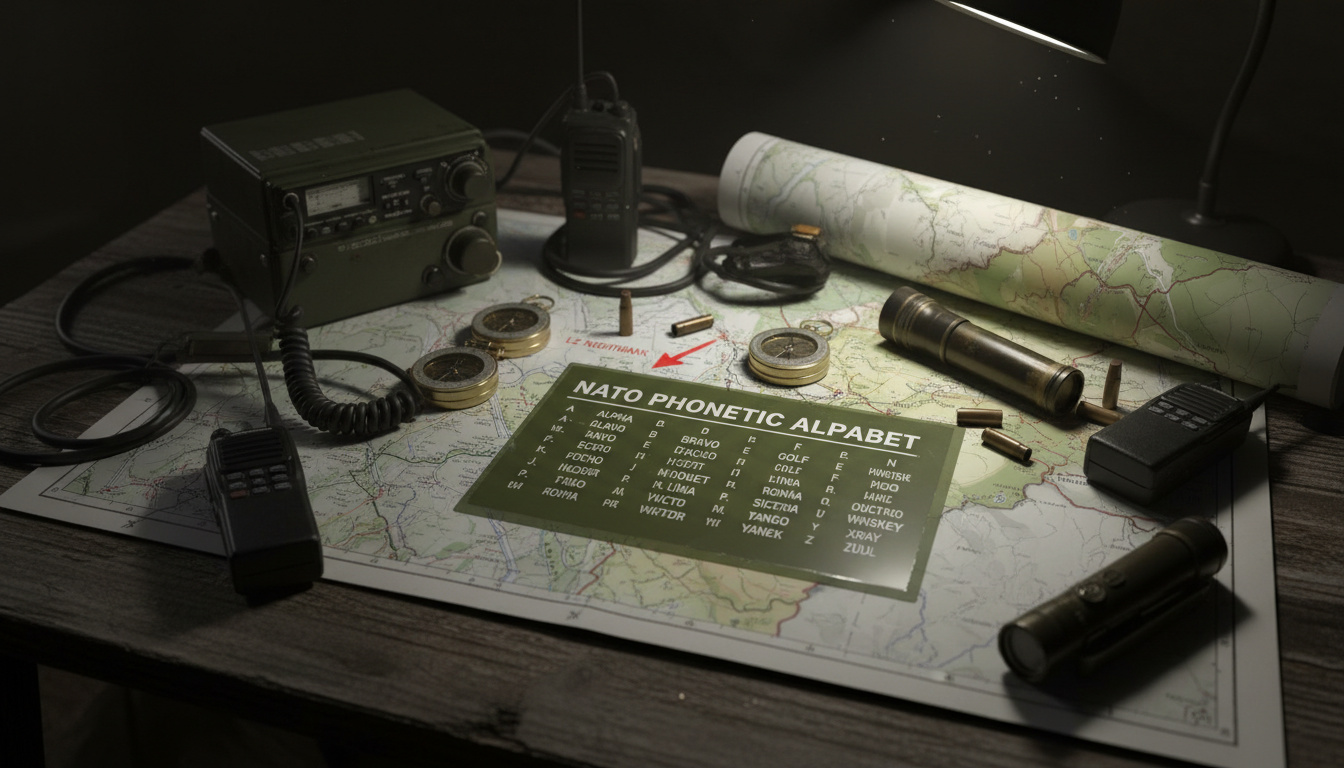

The NATO Phonetic Alphabet, officially designated the International Radiotelephony Spelling Alphabet, represents the global standard for verbal clarification of letters in high-stakes communication environments. Developed to eliminate fatal misunderstandings caused by static, accents, or similar-sounding characters, this system assigns distinct code words—Alfa, Bravo, Charlie—to each of the 26 English letters. First standardized in 1956 by the International Civil Aviation Organization (ICAO) and subsequently adopted by NATO, the alphabet now underpins safety protocols across aviation, maritime operations, emergency response, and military command centers worldwide.
Unlike earlier military codes that varied by nation, the current system underwent rigorous linguistic testing to ensure pronounceability across languages and dialects. The result is a protocol that remains virtually unchanged nearly seven decades later, demonstrating its effectiveness in reducing communication errors by providing unambiguous verbal signatures for every character.
While commonly associated with cockpit radio traffic and battlefield coordinates, the alphabet has permeated civilian sectors including customer service centers, amateur radio clubs, and logistics operations where precise data transmission proves critical.
What Is the NATO Phonetic Alphabet?
The system serves as a spelling alphabet specifically designed to clarify verbal communication when letters might be confused. Each of the 26 code words was selected based on distinctiveness in sound and ease of pronunciation across multiple languages, a criterion established through extensive international testing.
Clear radio and military communications
ICAO 1956, adopted by NATO
26 unique words for A-Z
Aviation, police, emergency services
- Standardized internationally following World War II to replace disparate national systems
- Reduces critical miscommunication errors in noisy or high-stress environments
- Identical to the ICAO phonetic alphabet used in civil aviation
- Maintains distinct pronunciations for numerals separate from the letter codes
- Recognized universally regardless of speaker’s native language or accent
- Remains unchanged since initial adoption, proving its linguistic robustness
| Letter | Code Word | Pronunciation |
|---|---|---|
| A | Alfa | AL-FAH |
| B | Bravo | BRAH-VOH |
| C | Charlie | CHAR-LEE |
| D | Delta | DELL-TAH |
| E | Echo | ECK-OH |
| F | Foxtrot | FOKS-TROT |
Complete List of NATO Phonetic Alphabet Words
The following chart presents the full standardized list alongside precise phonetic pronunciations. Note that certain spellings deviate from common English usage to accommodate international pronunciation standards.
Full Alphabet Chart
| Letter | Code Word | Pronunciation |
|---|---|---|
| A | Alfa | AL-FAH |
| B | Bravo | BRAH-VOH |
| C | Charlie | CHAR-LEE |
| D | Delta | DELL-TAH |
| E | Echo | ECK-OH |
| F | Foxtrot | FOKS-TROT |
| G | Golf | GOLF |
| H | Hotel | HOH-TEL |
| I | India | IN-DEE-AH |
| J | Juliett | JEW-LEE-ETT |
| K | Kilo | KEY-LOH |
| L | Lima | LEE-MAH |
| M | Mike | MIKE |
| N | November | NO-VEM-BER |
| O | Oscar | OSS-CAH |
| P | Papa | PAH-PAH |
| Q | Quebec | KEH-BEK |
| R | Romeo | ROW-ME-OH |
| S | Sierra | SEE-AIR-AH |
| T | Tango | TANG-GO |
| U | Uniform | YOU-NEE-FORM |
| V | Victor | VIK-TAH |
| W | Whiskey | WISS-KEY |
| X | X-ray | ECKS-RAY |
| Y | Yankee | YANG-KEE |
| Z | Zulu | ZOO-LOO |
Numeric Pronunciations
Numbers utilize modified pronunciations to prevent confusion, particularly between similar-sounding digits like five and nine. Multi-digit numbers are spoken digit-by-digit rather than as whole words.
| Number | Pronunciation |
|---|---|
| 0 | ZEE-RO |
| 1 | WUN |
| 2 | TOO |
| 3 | TREE |
| 4 | FOW-ER |
| 5 | FIFE |
| 6 | SIX |
| 7 | SEV-EN |
| 8 | AIT |
| 9 | NIN-ER |
| 100 | HUN-DRED |
| 1000 | TOU-SAND |
The code word for A appears as “Alfa” rather than “Alpha,” while J appears as “Juliett” with two T’s. These spellings were deliberately chosen during the 1956 standardization to ensure speakers of Spanish, French, and other languages pronounce the final consonants distinctly, avoiding confusion with other words.
Printable Resources
Official documentation and high-resolution charts are available through several verified sources. NYC-ARECS maintains a basic PDF chart, while CallCentreHelper provides printable posters optimized for call center environments. Additional standardized charts are available through Canadian maritime certification resources.
How Do You Use the NATO Phonetic Alphabet?
Proper usage requires more than memorizing the word list; it demands adherence to specific radio procedures that maximize clarity. Operators must speak deliberately, maintaining consistent volume and pace regardless of transmission stress.
Radio Communication Protocols
When spelling a word or callsign, precede the sequence with the phrase “I spell” to alert the recipient that clarification follows. For example, when transmitting the word “FOXTROT,” one would state: “Station callsign, message is FOXTROT OSCAR X-RAY TANGO ROMEO INDIA OSCAR TANGO, I spell: Foxtrot-Oscar-X-ray-Tango-Romeo-India-Oscar-TANGO.” This redundancy protocol ensures accuracy even if static interrupts the initial transmission.
Pronunciation Techniques
Emphasize each syllable equally without dropping final consonants. Variations exist for certain words depending on regional accent—”Charlie” may sound like CHAR-LEE or SHAR-LEE, while “Uniform” appears as YOU-NEE-FORM or OO-NEE-FORM—though both pronunciations remain acceptable within the standard. The critical requirement is distinctness from other code words and numbers.
History and Origin of the NATO Phonetic Alphabet
The system’s development spans decades of international cooperation, emerging from the chaos of incompatible wartime codes used during the Second World War.
Pre-WWII Telegraphy Codes
Before global standardization, individual nations developed phonetic alphabets independently for telegraphy and early aviation. The United States military employed “Able” for A, while British forces used different conventions entirely. This fragmentation created significant operational friction during joint Allied operations.
The Able-Baker Confusion
During World War II, American forces utilized the “Able-Baker” system where A stood for Able and B for Baker, while the Royal Air Force operated under separate protocols. Such discrepancies led to dangerous misunderstandings during coordinated missions, prompting post-war standardization initiatives through the newly formed ICAO.
During the Second World War, Allied forces struggled with incompatible phonetic systems. American units used “Able-Baker” while British forces employed different conventions, creating dangerous ambiguity during joint operations. This friction directly motivated post-war international standardization efforts.
ICAO Development and Testing
Between 1947 and 1956, ICAO linguists tested hundreds of word combinations across multiple languages to select terms that would be pronounceable by speakers of Arabic, Chinese, English, French, Spanish, and Russian. Extensive testing criteria required words to be easy to pronounce while presenting minimal risk of confusion with other terms or numbers.
Contrary to popular belief, the alphabet was not created by NATO originally. The organization adopted the system after ICAO developed and tested it extensively. NATO’s role came in mandating its use across member nations for military interoperability.
How the NATO Phonetic Alphabet Evolved
- : Early aviation and telegraphy codes emerge independently across nations
- : WWII forces use disparate systems like Able-Baker, causing confusion
- : ICAO develops initial draft alphabet for international use
- : Provisional alphabet adopted pending further testing
- : Final version standardized by ICAO and NATO
- : System expands to police, emergency services, and civilian aviation
Established Facts vs. Common Uncertainties
- Standardized in 1956 by ICAO and NATO
- 26 specific words with defined spellings
- Universal adoption in international aviation
- No official variations or regional dialects permitted
- Minor pronunciation variations for “Charlie” and “Uniform” based on regional accent
- Precise individual authorship of specific code words undocumented
- Exact metrics on error reduction rates not publicly archived
Modern Applications Beyond Military Operations
Today the alphabet serves functions far beyond its original military scope. Military communication protocols remain the most visible application, yet civilian aviation continues as the largest daily user, with every international flight relying on these code words for clearances and identifiers. Maritime operators use the system to prevent confusion during distress calls, while police and emergency medical services employ it to verify addresses and license plates over radio.
Customer service centers utilize the alphabet to confirm spelling of names and serial numbers, reducing transcription errors in databases. Amateur radio operators maintain proficiency as a licensing requirement in many jurisdictions. Even video gaming communities have adopted the alphabet for coordinating team tactics in voice chat, demonstrating the system’s versatility across any field requiring precise verbal data transmission.
Authority and Documentation
The International Radiotelephony Spelling Alphabet was designed to ensure clarity in communication between individuals with different accents and languages, particularly in high-noise environments.
— NATO Official Communications
Extensive testing across languages ensured universality, with criteria requiring words to be easy to pronounce and present low confusion risk.
— Aviation Communication Analysis
Summary
The NATO Phonetic Alphabet stands as one of the most successful international standardization efforts in communication history. Born from wartime necessity and refined through rigorous linguistic testing, the system continues to safeguard lives across aviation, emergency response, and military operations worldwide. Its unchanged status since 1956 testifies to the durability of its design, while its expansion into civilian sectors ensures that the code words remain relevant for any professional requiring error-free verbal data transmission.
Frequently Asked Questions
Why is the NATO phonetic alphabet used?
The alphabet eliminates confusion between similar-sounding letters like B and D, or M and N, particularly over radio channels with static or when speakers have different accents. This reduces critical errors in military, aviation, and emergency communications.
How do you pronounce NATO phonetic alphabet words?
Speak each code word deliberately with emphasis on distinct syllables. For example, “Alfa” becomes AL-FAH, while “Juliett” is JEW-LEE-ETT. Numbers have modified forms like “niner” for nine and “fife” for five to prevent digit confusion.
Is there a standard NATO phonetic alphabet chart?
Yes, ICAO and NATO maintain the official standard consisting of 26 code words from Alfa to Zulu. Printable charts are available through aviation authorities, emergency communication organizations, and military documentation centers.
What does each letter stand for in the NATO phonetic alphabet?
Each letter corresponds to a specific code word: A-Alfa, B-Bravo, C-Charlie, D-Delta, E-Echo, F-Foxtrot, G-Golf, H-Hotel, I-India, J-Juliett, K-Kilo, L-Lima, M-Mike, N-November, O-Oscar, P-Papa, Q-Quebec, R-Romeo, S-Sierra, T-Tango, U-Uniform, V-Victor, W-Whiskey, X-X-ray, Y-Yankee, Z-Zulu.
Where did the NATO phonetic alphabet come from?
ICAO developed the alphabet between 1947 and 1956 through extensive international testing to replace disparate WWII systems. NATO subsequently adopted it for military use, though ICAO retains technical authority over the standard for civil aviation.

Andrew Patel leads fact-checking, source verification and corrections at Oz Briefly.